

Trees growing too close to a power line
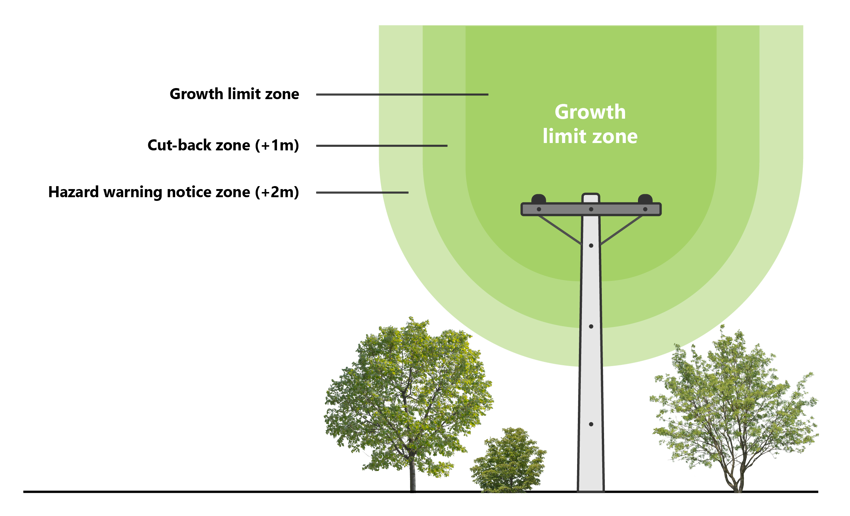
The tree regulations include three zones around a power line. These help explain when vegetation is getting too close and when it needs to be cut back.
Growth limit zone: The space immediately around a power line that must be kept clear of vegetation. The size and shape of the growth limit zone depends on the voltage of the line and, in some cases, the span length of the line.
Cut-back zone: This extends 1 metre out from the growth limit zone. If a tree is growing into the growth limit zone, it needs to be trimmed back far enough to reach the cut-back zone unless a dispensation applies.
Hazard warning notice zone: This extends 2 metres out from the growth limit zone. If vegetation enters this zone, we may issue a hazard warning notice to alert the tree owner.
If a tree qualifies for its first cut or trim under the regulations, we will cover reasonable costs. After that, keeping the tree clear of the power line, and paying for any trimming that’s needed, is the tree owner’s responsibility.
Different rules can apply in some circumstances, so check with us if you're unsure.
Trees that could fall into a power line
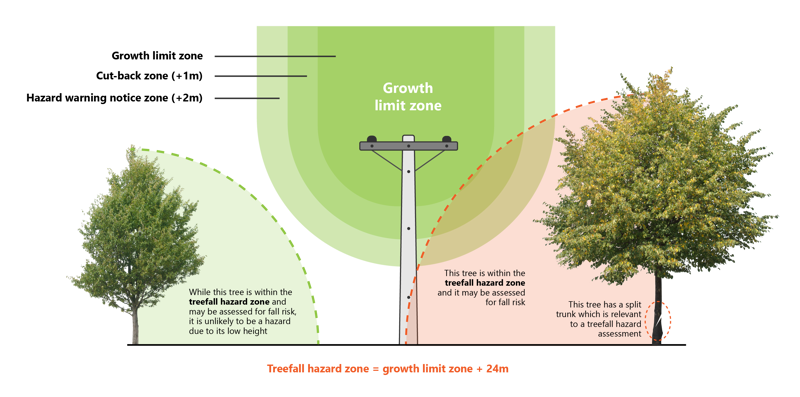
The treefall hazard zone is an area that extends 24 metres from the growth limit zone.
Trees within this zone may be assessed by a lines company. This does not mean every tree in the zone is a hazard. It means the tree may be assessed if there is concern that, because of its condition, size or location, it could fall onto the power line. A formal treefall hazard notice can only be issued if the tree is assessed as a moderate or high hazard.
Treefall hazard notices will not be issued before 23 July 2028. Before then, we may use voluntary processes to discuss hazardous trees with tree owners. These voluntary processes are separate from the formal treefall hazard notice power in the regulations.
Planting a new tree near a power line
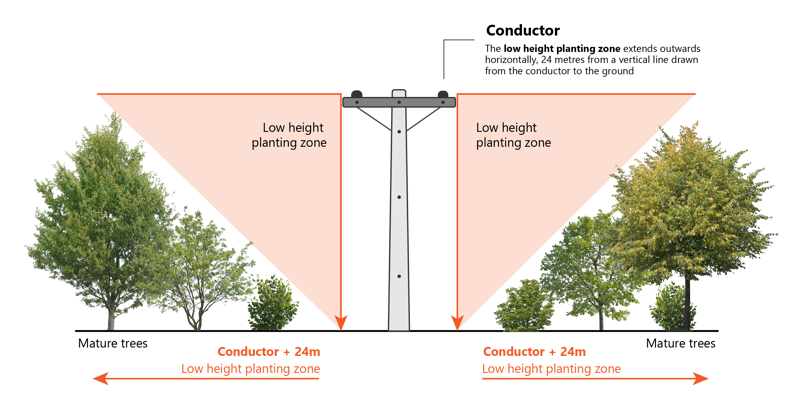
On 23 July 2027, a low height planting rule comes into effect. This means you must not plant a tree if you reasonably expect it could grow taller than its distance from the power line.
The low height planting zone extends 24 metres horizontally from the power line.
If you plant a tree in breach of this rule:
you may be liable for damages.
you may be responsible for the cost if the tree later needs to be cut, trimmed or removed.
you cannot use a ‘no-interest’ tree notice to transfer responsibility for managing the tree to us.
The planting restriction does not apply to trees that grow naturally. However, if a self-sown tree within the low height planting zone later needs to be cut, trimmed or removed, the tree owner may be responsible for the cost.
There are some exceptions. The low height planting zone does not apply:
on existing forest land.
in urban areas.
to shelterbelts.
on land administered under the Conservation Act 1987.
Not sure whether your property is in an urban area? Check your district plan or contact your local council.
Vegetation growing above the line – ‘clear to the sky’
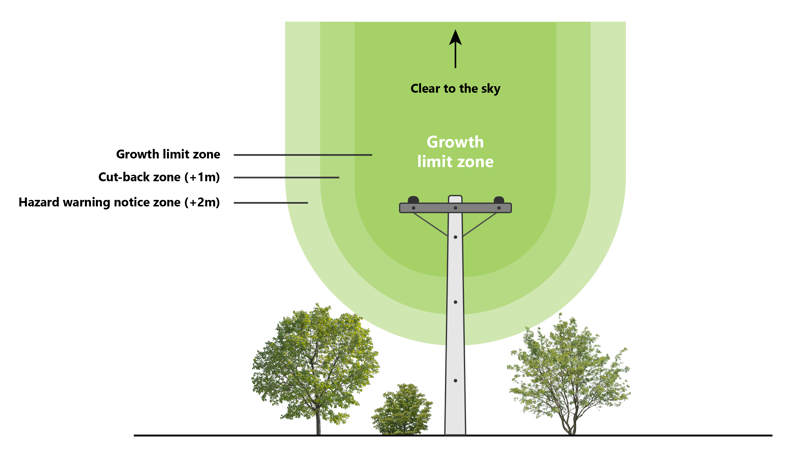
For some power lines, the growth limit zone extends vertically above the line as well as around it. This is known as ‘clear to the sky’ and means vegetation must also be kept clear above the line.
Clear to the sky applies to higher-voltage lines in both urban and non-urban areas. Since 17 October 2026, it also applies to lines at 11 kV or below, outside urban areas.
Clearances by Zone & Line Voltage
Line Voltage | Growth | Cut-back | Notice |
|---|---|---|---|
Low voltage (230-400V) | 0.5m | 1.5m | 2.5m |
High voltage lines (11kV) | 1.6m | 2.6m | 3.6m |
High voltage lines (22-33kV) | 2.5m | 3.5m | 4.5m |